Complete Guide to Cookidoo: Tricks, Tips and How to Share it
 (No Ratings Yet)
 Loading... (No Ratings Yet)Loading...
In the age of digital subscriptions, the average user is overwhelmed. Netflix, Spotify, Amazon Prime and, for cooking lovers, Cookidoo. With a price of around €60 per year, many users ask themselves the same question: Do I really need to pay 100% if I only use it three times a week?
This is where the phenomenon of “shared accounts” is born. What started as a favor between sisters or mothers and daughters has evolved into WhatsApp groups of four or five people who split the bill so that access to the official Vorwerk recipe book is almost symbolic. But is all that glitters gold? In this article we analyze the reality of sharing Cookidoo between four people.
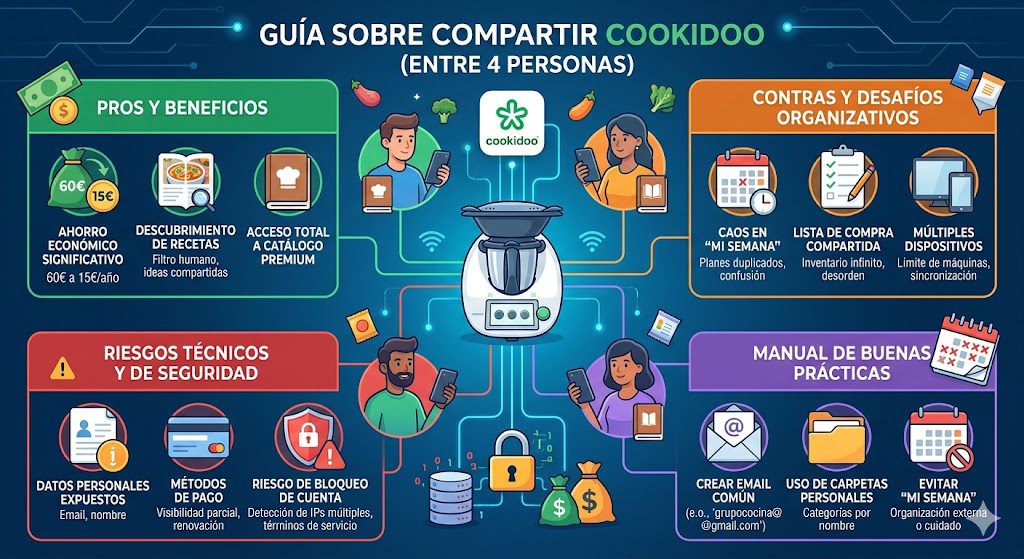
The main benefit is obvious: saving.
Individual cost: €60/year (approx.).
Cost shared between 4: €15/year.
For the price of three coffees a year, the user has access to more than 90,000 recipes, high definition videos and direct synchronization with their TM6. For many families, this savings is the difference between renewing the subscription or returning to cooking “by eye” or with paper books.
In addition to savings, sharing an account generates community dynamics.
Recipe Discovery: When you log in, you can see the lists your friends have created. “If Marta has saved this cheesecake recipe, it will be because it is good.” A human quality filter is created.
Full access: There are no limitations in the catalog. All four people enjoy the same premium experience as an individual user.
This is where the article needs to get serious. Sharing an account designed for a single user has implications that most ignore.
Cookidoo does not have independent “profiles” like Netflix. Share Cookidoo means share your digital identity.
Profile access: Any of the four people can enter the account settings and see the owner’s name and email.
Payment methods: If the credit card is saved for automatic renewal, even if the system hides some of the numbering, there is unnecessary exposure of financial data.
Vorwerk, the parent company, has the technical ability to see where each machine is connected from. If an account is used simultaneously in Madrid, Barcelona, Seville and Bilbao, the system detects that it is not a traditional “home”. Although the policy has been lax until today, the risk of a account blocking (ban) It is always latent.
This is the point that generates the most friction among users. Cookidoo is a “mirror” system: what one does appears to everyone.
If you have planned to cook a vichyssoise on Tuesday, and another user adds a beef stew For the same day, your Thermomix screen will show both. This may seem minor, but on a day-to-day basis, it leads to confusion and accidental deletions of dinner plans.
The Cookidoo application generates an automatic shopping list. If all four people use this function at the same time, the list becomes an infinite inventory of ingredients where it is impossible to distinguish what you need and what your neighbor needs.
⚠️ Be very careful with scams on social networks! Beyond the technical inconveniences, there is a much more serious threat on the network: financial scams. In Facebook groups, Telegram or cooking forums, it is increasingly common to find profiles that offer themselves as “organizers” to create groups of 4 or 5 people and divide the cost of the subscription. These individuals act as ringleaders, collect the money from the interested parties and, once they have the amount of all the fees in their possession, disappear completely. The scammer usually relies on fake profiles which is deleted after the deception, leaving users without their money and without access to Cookidoo. Since the amounts are small, they know that many victims will not report them. Therefore, the golden rule is clear: Never share an account or money with strangers on the internet. Total trust between members is the only ingredient that guarantees that savings will not be expensive. |
If after reading the risks you decide to continue, here is the “survival protocol” that the experts use:
Create a “bridge” email: Never use someone’s personal email. Create an account in Gmail type [email protected] and that everyone has the key.
Strict use of Folders: Do not save recipes in “Bookmarks”. Create folders with your names: [LISTA ANA], [LISTA BEATRIZ]etc. Respecting other people’s folders is the golden rule.
Do not touch “My Week”: It is better to use planning outside the app or be very aware that it is a shared space.
Previous common pot: Don’t wait for the subscription charge to arrive. Have a small fund or do the Bizum a week before to avoid the account expiring and the four of you being “stuck” in the middle of a recipe.
Legally, by accepting the Terms and Conditions of Cookidoo, the user agrees to personal use. Vorwerk could, if it wanted, restrict access to a single machine serial number (as some professional software does).
From an ethical point of view, there is a debate: does this harm the brand? On the one hand, they stop receiving three subscriptions. On the other hand, they keep four users “hooked” to their ecosystem, which makes it more likely that they will buy accessories or even the new model of the machine in the future.
Sharing Cookidoo between four people is an excellent way to democratize access to guided cooking, but it is not for everyone.
It’s for you if: You have a group of absolute trust, you are organized and you don’t mind that your cooking history is public to the rest of the group.
It is not for you if: You value your privacy a lot, you get stressed by digital clutter or you want to use the weekly planning function intensively.
Ultimately, saving €45 a year is attractive, but the peace of mind of having your own account, where your planning is yours alone, is something that many users end up valuing more over time.








NOTE: INTERESTING RECIPES FOR THIS NEW YEAR… I’m sure you are also interested in these recipes.
















 How to remove red wine stains: complete guide
 Tricks and Tips with the forming and baking in the roscones de Reyes
 How to Peel Almonds in Thermomix: Tips and Tricks
 How to Remove Coffee Stains from Clothes and Upholstery: Tips and Tricks
 Recipes created by you on Cookidoo
 Complete anti-flu juice in Thermomix
 How to Remove Scratches from Your Ceramic Cooktop: The Ultimate Guide
 Trace paper, perforated or nothing? The Ultimate Guide to Your Air Fryer
 cook pasta with thermomix – tips
 Second-hand thermomix TM6 or TM5: Tips for buying one
 Some tips for cleaning your thermomix
 20 Tips for Your Thermomix You Should Read and Keep in Mind
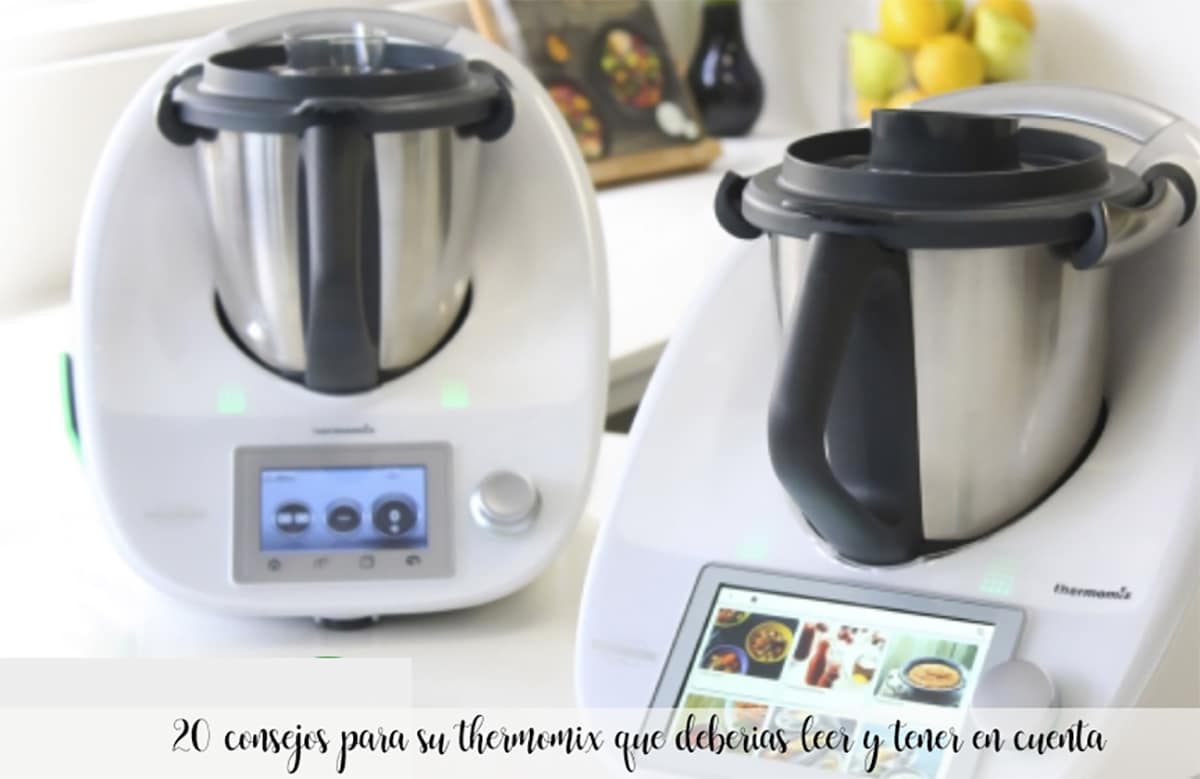 20 tips for your thermomix that you should read and take into account
 Heat jars in the Thermomix – Tricks
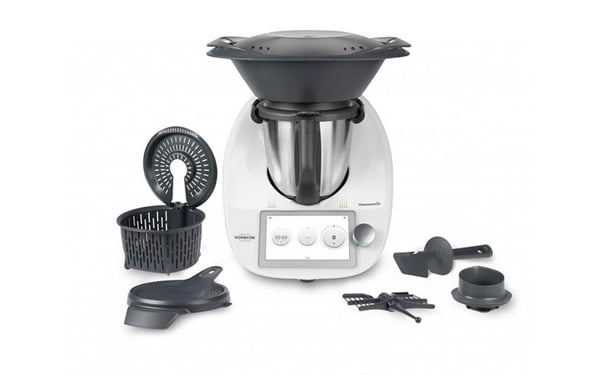 4 tricks to get the most out of your Thermomix